Class 9 Maths Number Systems Worksheet — Free Printable PDF
Download a free Class 9 Maths worksheet on Number Systems with MCQs, fill in the blanks and short answer questions. Complete answer key included. Personalized to your class, subject and chapter.
⭐ MeritMate — Class 9 Maths: Number Systems
Curriculum-Aware · meritmate.inSection A: Multiple Choice Questions
Q1. Which of the following is an irrational number?
a) 0.333...
b) √9
c) √7
d) 22/7
Q2. The decimal expansion of the number 1/3 is:
a) Terminating
b) Non-terminating and non-repeating
c) Non-terminating and repeating
d) None of these
Q3. Which of the following is NOT a real number?
a) √5
b) 0
c) √-4
d) -7
Q4. The value of (√3 + √2)(√3 - √2) is:
a) 5
b) 1
c) √6
d) 2√3
Q5. The rationalizing factor of 1/(√5 + 2) is:
a) √5 - 2
b) √5 + 2
c) 2 - √5
d) 1/√5
Section B: Fill in the Blanks
Q6. A number that can be expressed in the form p/q, where p and q are integers and q ≠ 0, is called a ________.
Q7. The decimal expansion of an irrational number is always non-terminating and ________.
Q8. Every rational number and irrational number together form the set of ________.
Q9. The value of 2^(1/3) multiplied by 2^(2/3) is equal to ________.
Q10. After rationalizing the denominator of 1/√7, the simplified form is ________.
Section C: Short Answer Questions
Q11. Show that 0.2353535... (0.235 with 35 repeating) is a rational number by expressing it in the form p/q.
Q12. Simplify: (√5 + √3)^2
Q13. Represent √5 on the number line using a geometric construction method.
Q14. Rationalize the denominator of the expression: 5/(3 + √11)
Q15. If a = 7 + 4√3, find the value of a + 1/a.
⭐ Answer Key
Class 9 · Maths · Number SystemsAnswer Key
Q1. c) √7
Explanation: √9 = 3 is rational, 22/7 and 0.333... are rational. √7 cannot be expressed as p/q and is therefore irrational.
Q2. c) Non-terminating and repeating
Explanation: 1/3 = 0.333... which is a repeating decimal and hence a rational number.
Q3. c) √-4
Explanation: √-4 is not defined in the real number system as the square root of a negative number is imaginary.
Q4. b) 1
Explanation: Using identity (a + b)(a - b) = a^2 - b^2, we get (√3)^2 - (√2)^2 = 3 - 2 = 1.
Q5. a) √5 - 2
Explanation: To rationalize 1/(√5 + 2), we multiply numerator and denominator by √5 - 2, the conjugate of √5 + 2.
Q6. Rational number
Q7. Non-repeating
Explanation: Irrational numbers have decimal expansions that never terminate and never form a repeating pattern.
Q8. Real numbers
Q9. 2
Explanation: 2^(1/3) x 2^(2/3) = 2^(1/3 + 2/3) = 2^1 = 2 using the law of exponents a^m x a^n = a^(m+n).
Q10. √7/7
Explanation: Multiply numerator and denominator by √7 to get √7/(√7 x √7) = √7/7.
Q11. Let x = 0.2353535...
Then 10x = 2.353535...
And 1000x = 235.353535...
Subtracting: 1000x - 10x = 235.353535... - 2.353535...
990x = 233
x = 233/990
Therefore 0.2353535... = 233/990, which is in p/q form, confirming it is rational.
Q12. (√5 + √3)^2 = (√5)^2 + 2(√5)(√3) + (√3)^2
Using identity (a + b)^2 = a^2 + 2ab + b^2
= 5 + 2√15 + 3
= 8 + 2√15
Q13. To represent √5 on the number line:
Step 1: Draw a number line and mark point O at 0 and point A at 2, so OA = 2 units.
Step 2: At point A, draw AB perpendicular to the number line such that AB = 1 unit.
Step 3: Join OB. By Pythagoras theorem, OB = √(OA^2 + AB^2) = √(4 + 1) = √5.
Step 4: With O as center and OB as radius, draw an arc cutting the number line at point P.
Step 5: Point P represents √5 on the number line.
Q14. 5/(3 + √11)
Multiply numerator and denominator by the conjugate (3 - √11):
= 5(3 - √11) / (3 + √11)(3 - √11)
= 5(3 - √11) / (9 - 11)
= 5(3 - √11) / (-2)
= -5(3 - √11) / 2
= (5√11 - 15) / 2
Q15. Given a = 7 + 4√3
1/a = 1/(7 + 4√3)
Rationalizing: multiply by (7 - 4√3)/(7 - 4√3)
1/a = (7 - 4√3) / (49 - 48) = (7 - 4√3)
More Class 9 Maths Worksheets
Want a different worksheet on Number Systems?
Generate a fresh set of unique questions instantly. ✨ Generate My Free Worksheet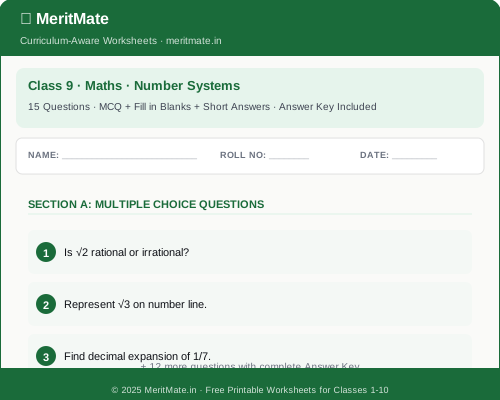
Sample preview — Download full worksheet with complete answer key