Class 10 Maths Quadratic Equations Worksheet — Free Printable PDF
Download a free Class 10 Maths worksheet on Quadratic Equations with MCQs, fill in the blanks and short answer questions. Complete answer key included. Personalized to your class, subject and chapter.
⭐ MeritMate — Class 10 Maths: Quadratic Equations
Curriculum-Aware · meritmate.inSection A: Multiple Choice Questions
Q1. Which of the following is a quadratic equation?
a) x³ + 2x + 1 = 0
b) x² + 3x - 4 = 0
c) x + 5 = 0
d) 2x - 7 = 1
Q2. The discriminant of the equation 2x² - 4x + 3 = 0 is:
a) 8
b) -8
c) 16
d) -16
Q3. The roots of the equation x² - 5x + 6 = 0 are:
a) 2 and 4
b) -2 and -3
c) 2 and 3
d) 1 and 6
Q4. If the discriminant of a quadratic equation is zero, then the roots are:
a) real and distinct
b) not real
c) real and equal
d) irrational
Q5. The sum of the roots of the equation 3x² - 7x + 2 = 0 is:
a) 2/3
b) 7/3
c) -7/3
d) 3/7
Section B: Fill in the Blanks
Q6. The standard form of a quadratic equation is ________.
Q7. The product of roots of the equation 5x² - 3x + 1 = 0 is ________.
Q8. If one root of x² - 6x + k = 0 is 4, then the value of k is ________.
Q9. The roots of the equation x² - 9 = 0 are ________.
Q10. A quadratic equation has at most ________ roots.
Section C: Short Answer Questions
Q11. Find the roots of the quadratic equation 2x² - 5x + 3 = 0 by factorisation.
Q12. Find the discriminant of the equation x² - 4x + 5 = 0 and state the nature of roots.
Q13. Find the value of k for which the equation kx² + 2x + 1 = 0 has equal roots.
Q14. Solve the equation 3x² - x - 2 = 0 using the quadratic formula.
Q15. The product of two consecutive positive integers is 56. Represent this situation as a quadratic equation and find the integers.
⭐ Answer Key
Class 10 · Maths · Quadratic EquationsAnswer Key
Q1. b) x² + 3x - 4 = 0
Q2. b) -8
Discriminant = b² - 4ac = (-4)² - 4(2)(3) = 16 - 24 = -8
Q3. c) 2 and 3
x² - 5x + 6 = 0 gives (x - 2)(x - 3) = 0, so x = 2 or x = 3
Q4. c) real and equal
Q5. b) 7/3
Sum of roots = -b/a = -(-7)/3 = 7/3
Q6. ax² + bx + c = 0, where a, b, c are real numbers and a is not equal to 0
Q7. 1/5
Product of roots = c/a = 1/5
Q8. k = 8
Since x = 4 is a root: 16 - 24 + k = 0, so k = 8
Q9. x = 3 and x = -3
Q10. Two
Q11. 2x² - 5x + 3 = 0
2x² - 2x - 3x + 3 = 0
2x(x - 1) - 3(x - 1) = 0
(2x - 3)(x - 1) = 0
x = 3/2 or x = 1
Q12. D = b² - 4ac = (-4)² - 4(1)(5) = 16 - 20 = -4
Since D is less than 0, the roots are not real (complex conjugate roots).
Q13. For equal roots, D = 0
b² - 4ac = 0
(2)² - 4(k)(1) = 0
4 - 4k = 0
k = 1
Q14. 3x² - x - 2 = 0
a = 3, b = -1, c = -2
D = 1 + 24 = 25
x = (1 plus or minus 5) / 6
x = 1 or x = -2/3
Q15. Let the integers be x and x + 1.
x(x + 1) = 56
x² + x - 56 = 0
(x + 8)(x - 7) = 0
x = 7 (taking positive value)
The two consecutive positive integers are 7 and 8.
More Class 10 Maths Worksheets
Want a different worksheet on Quadratic Equations?
Generate a fresh set of unique questions instantly. ✨ Generate My Free Worksheet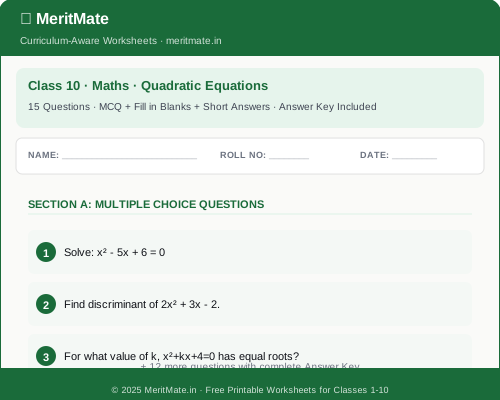
Sample preview — Download full worksheet with complete answer key