Class 10 Maths Real Numbers Worksheet — Free Printable PDF
Download a free Class 10 Maths worksheet on Real Numbers with MCQs, fill in the blanks and short answer questions. Complete answer key included. Personalized to your class, subject and chapter.
⭐ MeritMate — Class 10 Maths: Real Numbers
Curriculum-Aware · meritmate.inSection A: Multiple Choice Questions
Q1. The decimal expansion of 17/8 is:
a) terminating
b) non-terminating repeating
c) non-terminating non-repeating
d) none of these
Q2. The HCF of 96 and 404 is:
a) 2
b) 4
c) 6
d) 8
Q3. Which of the following is an irrational number?
a) sqrt(16)
b) sqrt(25)
c) sqrt(36)
d) sqrt(7)
Q4. The prime factorisation of 144 is:
a) 2 raised to 3 multiplied by 3 raised to 2
b) 2 raised to 4 multiplied by 3 raised to 2
c) 2 raised to 2 multiplied by 3 raised to 4
d) 2 raised to 3 multiplied by 3 raised to 3
Q5. If HCF of two numbers is 4 and their LCM is 36, and one number is 12, the other number is:
a) 9
b) 12
c) 16
d) 18
Section B: Fill in the Blanks
Q6. The product of two irrational numbers is ________.
Q7. The HCF of two prime numbers is always ________.
Q8. Every composite number can be expressed as a product of primes, and this factorisation is unique apart from the order of factors. This is called the ________.
Q9. The decimal expansion of 13/625 is ________.
Q10. For any two positive integers a and b, HCF multiplied by LCM equals ________.
Section C: Short Answer Questions
Q11. Show that 5 minus sqrt(3) is irrational.
Assume 5 minus sqrt(3) is rational. Then 5 minus sqrt(3) equals p/q where p and q are integers and q is not equal to 0. This gives sqrt(3) equals 5 minus p/q, which is rational. But sqrt(3) is irrational, which is a contradiction. Therefore 5 minus sqrt(3) is irrational.
Q12. Find the HCF and LCM of 12, 15 and 21 using prime factorisation.
12 equals 2 raised to 2 multiplied by 3
15 equals 3 multiplied by 5
21 equals 3 multiplied by 7
HCF equals 3
LCM equals 2 raised to 2 multiplied by 3 multiplied by 5 multiplied by 7 equals 420
Q13. Prove that sqrt(2) is irrational.
Assume sqrt(2) is rational. Then sqrt(2) equals p/q where HCF of p and q is 1. Squaring both sides gives 2 equals p squared divided by q squared, so p squared equals 2q squared. This means 2 divides p squared, so 2 divides p. Let p equals 2m. Then 4m squared equals 2q squared, giving q squared equals 2m squared. So 2 divides q as well. This contradicts HCF of p and q being 1. Therefore sqrt(2) is irrational.
Q14. Check whether 6 raised to n can end with the digit 0 for any natural number n.
For a number to end with 0, it must have 2 and 5 as prime factors. The prime factorisation of 6 raised to n is 2 raised to n multiplied by 3 raised to n. Since 5 is not a factor of 6 raised to n, it cannot end with the digit 0 for any natural number n.
Q15. Find the LCM of 96 and 360 using prime factorisation.
96 equals 2 raised to 5 multiplied by 3
360 equals 2 raised to 3 multiplied by 3 raised to 2 multiplied by 5
LCM equals 2 raised to 5 multiplied by 3 raised to 2 multiplied by 5 equals 32 multiplied by 9 multiplied by 5 equals 1440
⭐ Answer Key
Class 10 · Maths · Real NumbersAnswer Key
Q1. a) terminating
Q2. b) 4
Q3. d) sqrt(7)
Q4. b) 2 raised to 4 multiplied by 3 raised to 2
Q5. b) 12
Q6. not always irrational; it can be rational or irrational
Q7. 1
Q8. Fundamental Theorem of Arithmetic
Q9. 0.02080 (terminating)
Q10. the product of the two numbers, that is a multiplied by b
Q11. 5 minus sqrt(3) is irrational as proved by contradiction since sqrt(3) is irrational
Q12. HCF equals 3 and LCM equals 420
Q13. sqrt(2) is irrational as proved by contradiction using the method of assuming it is rational
Q14. 6 raised to n cannot end with digit 0 for any natural number n since 5 is not a prime factor of 6 raised to n
Q15. LCM of 96 and 360 is 1440
More Class 10 Maths Worksheets
Want a different worksheet on Real Numbers?
Generate a fresh set of unique questions instantly. ✨ Generate My Free Worksheet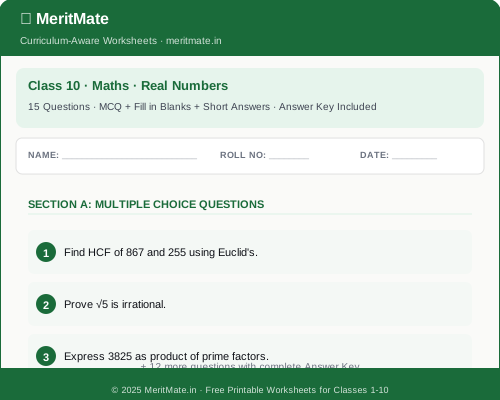
Sample preview — Download full worksheet with complete answer key